Portugal’s New Nationality Law Takes Effect This Tuesday — Transitional Rules Preserve Review Under the Previous Law
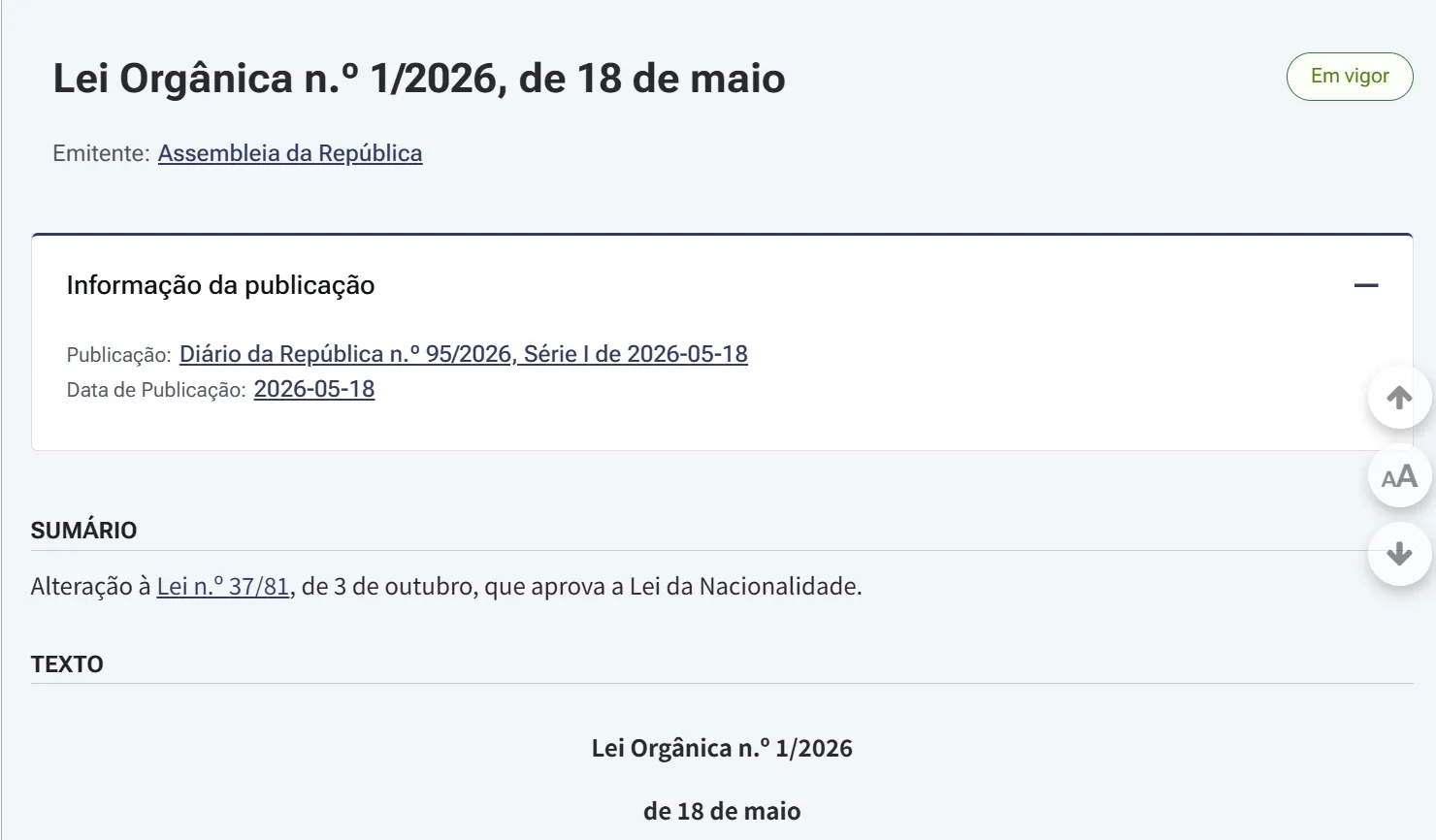
The new Nationality Law was published in the Official Gazette on Monday (18th) and will come into force in Portugal on Tuesday (19th). The decree was promulgated and signed by President António José Seguro on May 3. The most significant change introduced by the new law is the extension of the required period of lawful residence for foreigners applying for Portuguese nationality, substantially tightening the naturalization requirements.
Higher Naturalization Thresholds and Longer Residence Requirements
Under the new rules, the residence period required for foreign nationals legally residing in Portugal to obtain citizenship has been significantly increased.
According to the new provisions, citizens of the Community of Portuguese Language Countries (CPLP), such as Brazilian nationals, must now legally reside in Portugal for seven years before applying for nationality. For immigrants from other countries, the required period has been extended to ten years.
The new law also abolishes the previous practice of counting the waiting period for residence permits toward the nationality qualification period.
Another important change directly affects children born in Portugal to foreign parents. From now on, such children will no longer automatically acquire Portuguese nationality. At least one parent must have legally resided in Portugal for a minimum of five years at the time of the child’s birth.
The law further provides that minors born in Portugal may only acquire Portuguese nationality through naturalization if they are enrolled in and complete compulsory education, where applicable.
Transitional Provisions Confirm Pending Applications Will Continue Under the Previous Law
The decree expressly establishes transitional provisions stating that administrative nationality applications still pending on the date the new law enters into force will continue to be reviewed under the previous legal framework and will not be affected by the legislative changes.
Article 7, paragraph 2 (Artigo 7.º, n.º 2) states:
“Aos procedimentos administrativos pendentes à data da entrada em vigor da presente lei aplica-se a Lei n.º 37/81 […] na redação anterior…”
This means:
“Administrative procedures pending on the date this law enters into force shall continue to be governed by Law No. 37/81 […] in its previous wording.”
This provision reflects the Portuguese legislature’s protection of the principles of legal continuity and legitimate expectations of applicants.
In the explanatory statement accompanying the promulgation, President António José Seguro also specifically emphasized that the State should not harm the rights and interests of applicants already involved in ongoing administrative procedures merely because of legislative changes.
From the perspective of the Portuguese administrative legal system, obtaining Portuguese nationality is not regarded as a single, isolated, instantaneous act, but rather as part of a continuous administrative legal relationship built upon long-term lawful residence.
For applicants, lawful residence, residence renewals, maintenance of legal status, and eventual nationality applications all form part of a continuous administrative pathway.
Particularly important is the fact that Portugal’s nationality system itself is based on clear prerequisite conditions: nationality applications depend upon prior long-term lawful residence. Therefore, residence procedures and nationality procedures are not entirely separate but are legally interconnected and continuous in nature.
Accordingly, a significant legal interpretation currently being discussed within Portuguese legal circles deserves attention:
For applicants who have already established lawful residence under the framework of the previous law and have continuously complied with related administrative procedures, their accrued residence time and legal expectations should theoretically be protected under the principle of legitimate expectations (princípio da proteção da confiança), rather than being entirely interrupted or restarted because of the new law.
Furthermore, from the standpoint of legal application logic, applicants who had already completed five years of continuous lawful residence in Portugal before the new law entered into force — and who had therefore already met the legal qualifications for nationality under the previous law — are fundamentally different from individuals who had not yet begun establishing lawful residence relationships.
Under the framework of the previous Nationality Law, once an applicant completed the legally required period of lawful residence in Portugal, they had already acquired the statutory right to apply for nationality (direito de requerer a nacionalidade).
The formation of this legal entitlement was not dependent solely on the actual date of submission of the application, but rather arose from the long-standing and continuous lawful administrative relationship established beforehand.
Therefore, even if certain applicants formally submit their nationality applications only after the new law enters into force, the fact that they had already completed five years of lawful residence and had already fulfilled the statutory eligibility requirements during the validity of the previous law carries important legal significance in itself.
The government now has 90 days to amend and adjust the relevant regulations of the Nationality Law in accordance with the new rules approved by the Portuguese Parliament.
Further clarification is still expected through implementing regulations, administrative interpretations, and future judicial practice.
Accordingly, the more prudent and reasonable interpretation at the current stage is that although the new law has formally entered into force, for applicants who had already established lawful residence relationships under the framework of the previous law and who continue to pursue related administrative procedures, the applicable legal framework remains subject to ongoing interpretation and transitional institutional arrangements. It therefore cannot be simply understood as meaning that the previous law was entirely terminated on the very day the new law came into effect.
Reference link:
https://diariodarepublica.pt/dr/detalhe/lei-organica/1-2026-1123539996
For more details, please visit: https://adlinvestment.com/en/about/