Overview of Portugal’s Real Estate Market in 2026
As the European economy gradually recovers, Portugal’s real estate market continues to demonstrate strong resilience in 2026. Although transaction activity has slowed, rising property prices and continued inflows of international capital have kept Portugal firmly on the radar of global investors.

Sustained Price Growth
Over the past year, Portugal’s real estate market has shown robust performance. In 2025, housing prices increased by more than 16% year-on-year, and the upward trend has continued into 2026. The national average price has now exceeded €2,000 per square metre, while key regions such as Lisbon, Porto, and the Algarve remain significantly above this level.

The underlying driver of this trend remains a structural imbalance between supply and demand: a persistent shortage of housing, limited new construction, and land scarcity in major urban areas. With no substantial improvement on the supply side, prices are expected to remain supported in the short term.
Continued Inflow of International Capital
Transaction volumes in 2026 have begun to show signs of marginal slowdown compared to 2025. According to data from the Instituto Nacional de Estatística (INE), total residential transactions in 2025 still reached approximately 169,000 units, marking an annual increase of around 8.6%. However, by the end of the year, the market had already started to exhibit a pattern of “rising prices alongside slowing transaction activity.”
At the same time, the structure of demand is evolving. Data indicates that purchases by households accounted for 87.5% of transactions in 2025, the highest level in recent years, while institutional and speculative demand declined. This suggests a shift away from short-term capital-driven activity toward owner-occupiers and long-term investors.
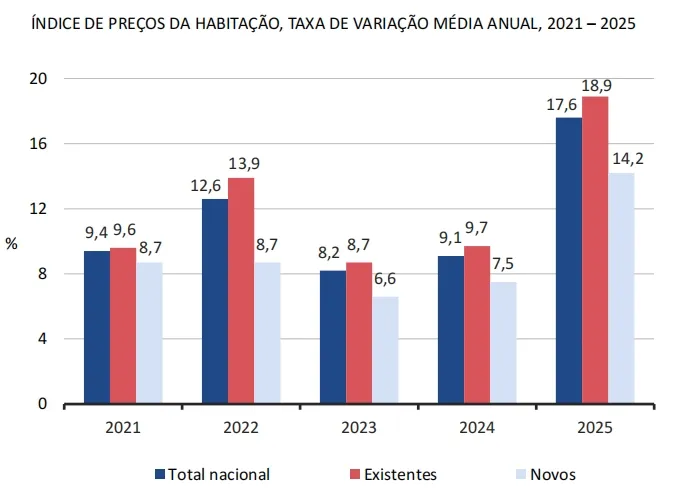 (source: INE)
Foreign buyer activity also showed signs of moderation, declining by approximately 13.3% year-on-year in 2025. As interest rates stabilised and acquisition costs increased, some buyers adopted a more cautious approach, contributing to the slowdown in transaction volumes. Nevertheless, demand has not disappeared—it is transitioning from high-frequency activity to a more rational allocation phase. International investors, digital nomads, retirees, and high-net-worth individuals continue to play a key role in supporting the market.
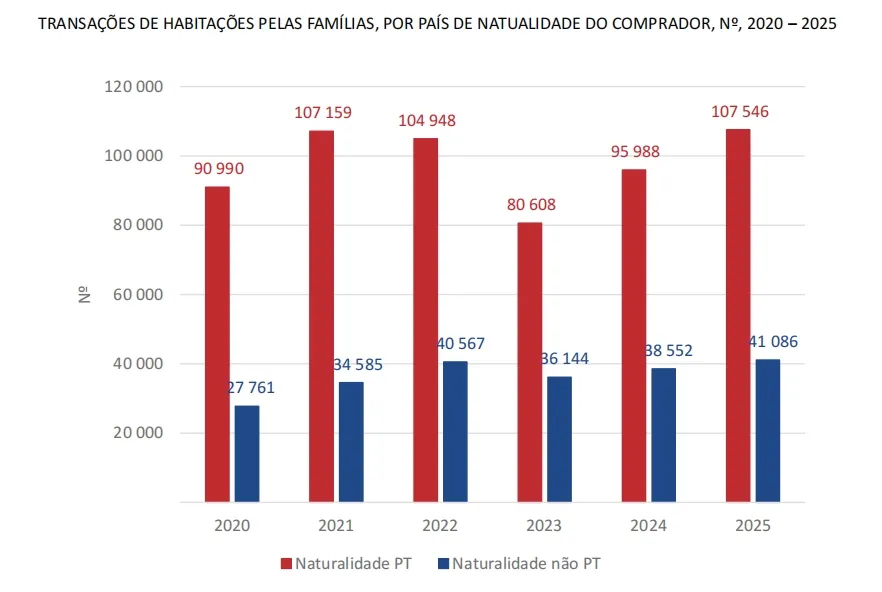 (source: INE)
Portugal’s appeal remains strong: high quality of life, a stable legal framework, relatively accessible entry points, and competitive rental yields. These factors continue to attract overseas buyers, particularly in Lisbon and the Algarve.
Growing Market Divergence and Shifting Investment Logic
The Portuguese real estate market is increasingly characterised by structural divergence. According to INE data, regions with prices consistently above the national average are concentrated in Greater Lisbon, the Algarve, and the Porto Metropolitan Area—areas that also face the greatest supply constraints.
In contrast, secondary markets offer lower entry prices. In regions such as Central Portugal and Alentejo, property prices remain around €1,500 per square metre, compared to over €4,000 per square metre in Lisbon. This price gap is becoming a key factor in investors’ asset allocation decisions.
From a behavioural perspective, transaction patterns are also changing. As interest rates rise and then stabilise, speculative demand has declined, while investments focused on rental income and long-term holding have gained prominence. Residential rental yields in Portugal have remained around 6% in recent years, maintaining their attractiveness within the European context.
Several institutions have highlighted this shift. For example, CBRE notes in its market reports that investors are moving away from short-term capital gains toward more stable, income-generating assets, with growing interest in sectors linked to tourism, urban regeneration, and infrastructure.
In this context, investment strategies are evolving—from “chasing price growth” to making more structural, long-term allocation decisions, focusing on value across different regions and asset classes.